Do Cheap Reading Glasses Damage Your Vision?
Most people start to have problems seeing clearly at close distances beginning in their early to mid-40s, particularly when reading or working on the computer. This is because our eyes and vision change over time, just like the rest of our bodies do. Cheap reading glasses from the drugstore seem like an easy fix, but can they damage your vision over time?
Reading glasses don’t damage vision. However, using the wrong strength can cause eyestrain, headaches, and blurry vision. Over-the-counter readers are affordable but may lack customization and durability. Prescription glasses offer precise correction for different vision needs. Regular eye exams are essential as presbyopia progresses.
Do Cheap Reading Glasses Damage Your Vision?
Cheap reading glasses, like any other glasses, do not inherently damage your vision. However, the wrong strength of glasses may strain your eyes or cause discomfort.
Using reading glasses with the wrong strength means that they magnify too much or too little. This can cause:
- Eyestrain
- Headaches
- Blurry vision
This is why it’s important to get the correct strength for your reading glasses. It’s worth noting that even inexpensive reading glasses can be effective. They just need to have the right prescription for your needs.
The cost doesn’t necessarily reflect their quality or appropriateness for your vision. However, you should still get an eye exam to determine the strength of the reading glasses you need.
When Do I Need Reading Glasses?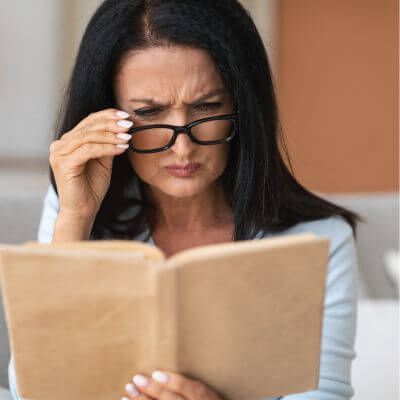
You may need reading glasses if you:
- Have difficulty focusing on close objects
- Have to hold reading material at arm’s length to see it clearly
- Suffer from eye strain or headaches during close-up tasks
These symptoms often indicate presbyopia . This is a common age-related eye condition that typically starts around the age of 40. Presbyopia is when the lens in your eye loses flexibility. Over time, it becomes harder for the eye to focus on nearby objects.
What Are Reading Glasses?
Also known as readers , reading glasses magnify nearby objects. This allows you to see them more clearly. They come in various strengths, measured in diopters , indicating their level of magnification.
These glasses are typically used for tasks that require close-up focus, such as:
- Reading
- Working on a computer
- Doing intricate crafts
They are not meant for activities that require clear distance vision.
Bifocals or progressive lenses may be recommended if you already wear prescription lenses. Bifocals have two prescriptions in one lens. The upper part is for distance vision and the lower part is for close-up tasks. Progressive lenses transition between both types of vision without the visible line in bifocals.
It’s important to have regular eye exams if you have presbyopia. It allows your eye doctor to monitor any vision changes. This ensures that the prescription for reading glasses remains accurate.
Readers vs. Prescription Lenses for Presbyopia
Readers
Generic over-the-counter reading glasses typically cost quite a bit less than prescription glasses. Their low cost also means:
- Lower quality
- Weaker frames
- Lenses that scratch easily
These glasses won’t correct other visual conditions such as nearsightedness or astigmatism. Readers also have the same prescription for each lens. They may not provide as much clarity as prescription glasses if your vision isn’t identical in both eyes, which is the case for most people.
With that said, readers can fit the bill if you need to quickly grab a pair of magnifying eyeglasses so you can read:
- The newspaper
- A menu
- Small print on a label
This is especially true considering their cost and convenience.
If you only need them occasionally, reading glasses can be a fine solution. You may experience eye fatigue and headaches if you need to wear them for an extended period. If you use them often, it may be time to schedule an appointment with your eye doctor and discuss prescription glasses as an option.
Prescription Glasses
Most people have different vision in each eye, so prescription glasses are a great option to address that. Corrections can be also made in each eye for:
- Nearsightedness
- Farsightedness
- Astigmatism
An optician will make lenses based on your prescription. This includes the distance between your pupils ( pupillary distance ) to get your best vision correction.
Prescription lenses are of higher quality and sharper clarity than cheap reading glasses. This makes them a better choice if you need long-term up-close vision correction.
Plus, prescription glasses can be made to cover:
- Vision correction
- Driving
- Seeing at a distance
Even if drugstore eyeglasses are sufficient for your vision needs, it’s still good to get a regular eye exam. A knowledgeable eye doctor will let you know which magnification level you need.
Keep in mind that presbyopia will continue to progress over time. You’ll likely need to change magnification levels or prescriptions at some point.
Comprehensive eye exams are the best way to determine exactly what’s going on with your vision. They’re also the best way to learn how to correct it. At Baptist Eye Surgeons, we’re happy to talk with you about options for helping you see clearly as you age.
Do you need help treating your presbyopia? Contact us today to schedule your appointment!

Reading glasses won’t harm your vision, but the wrong strength may lead to discomfort. While over-the-counter options are budget-friendly, they may lack customization and durability. Prescription glasses provide tailored correction for diverse vision requirements. Routine eye exams are crucial as presbyopia advances.
Baptist Eye Surgeons is an ophthalmological practice in Knoxville, TN, Morristown, TN, and Sevierville, TN. Give us a call at 865-579-3920 for more information or to schedule an appointment .
*Editor’s Note: This post was originally published in September 2018 and has been updated for comprehensiveness and new information.